
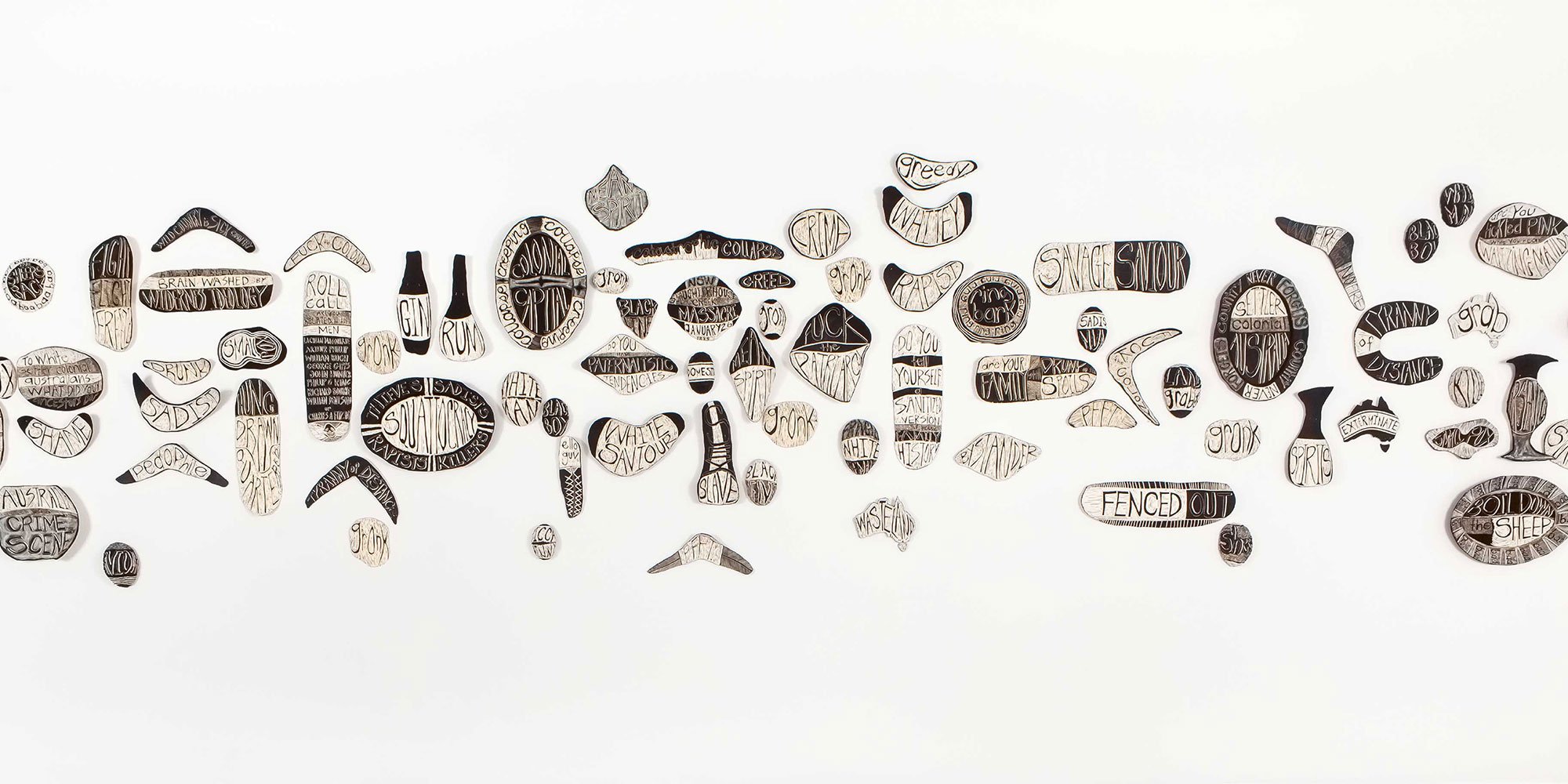
Penny Evans, IN Black and White (detail), 2023, porcelaneous white stoneware, black underglaze, carving. Image: Kat Valentine
IN Black and White
Penny Evans
Porcelaneous White Stoneware, Black Underglaze, Carving
From the week after the referendum I began a major body of text-based stoneware wall work as a response to the recent referendum in Australia (Oct 2023) asking to enshrine an Indigenous voice to parliament in the constitution, which was comprehensively voted down. The work was completed in January 2024.
The work is called IN Black & White and comprises 87 black and white stoneware hanging pieces with forms referencing boomerangs, shields, coolamons, colonial platters, plates.
The work is heavily carved and came from a strong reaction of anger. The work has an immediacy to it and wasn’t pre-planned. As I produced the work, I shared images on social media, which generated a lot of conversations around people’s family histories and connections to the Australian colonial frontiers, and also opened up space for some to connect to and unpack their white privilege in a meaningful way.
I am mixed heritage – Gamilaroi and colonial Irish, Scottish.
The series speaks directly to ‘white settler colonial Australians’ whose descendants make up twenty percent of our population.
The truth telling process in my opinion, is integral to black and white in Australia recovering from the legacies of, and ongoing genocidal and ecocidal occupation here.
Penny Evans, 2023
With thanks to the Australian Museum and Lake Macquarie Gallery, Yapang for generously loaning this artwork.
Artists: Penny Evans
Opening: Thursday 23 April 6pm
Exhibition: 24 April–30 May 2026
Where: BAMM Gallery
FREE
Biography
Penny Evans is a visual artist based in Widjabal country, Northern Rivers, NSW. Her practice is a process-driven inquiry, predominantly working with clay.
She is a descendant of Caroline Carr, a Gomeroi woman born at Gil Gil creek in 1846, and John Richards, a freed convict who worked on Balarang and Wellbondongah stations prior to owning Bengerang Station, just west of Garah on the Mungindi Rd. John Richards was a signatory on the founding document of Moree.
Her family is part of the deeper history of the area and are mixed blood. Reckoning with the past has been a catalyst for her artwork over the past 40 years. Coming to understand the experience of her family – both black and white, the true history of the ongoing colonisation of the area and negative impacts on Gomeroi mobs, and the destruction of sacred Gomeroi country have fuelled her practice.